Holding all the aces
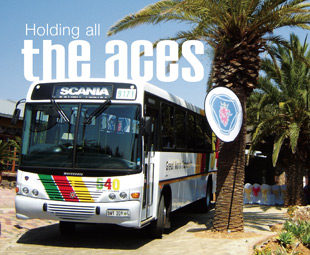
Successful companies are more often than not the result of good business partnerships and like-minded ideals. The Scania, Marcopolo and GNT partnership recently celebrated its 540th example of a thriving success story.
Gathered in Polokwane in early September to officially hand over Great North Transport’s (GNT) 540th bus, representatives from chassis manufacturer Scania, bus body builder Marcopolo and Limpopo-based commuting company GNT celebrated not only a momentous occasion, but the birth of an auspicious relationship for all three companies nine years ago.
“We aren’t gathered here today to celebrate the handover of GNT’s 540th bus,” said Roberto Virgili, national sales manager bus and coach, Scania SA, against all evidence to the contrary – particularly as the honoured guest of the event was the actual bus itself, emblazoned with the number 540 on its rear and sides.
“We’re here to celebrate the first bus we delivered, back in September 2000. Without that first bus, we would not have embarked on such a mutually successful relationship, and we would not be here today.”
GNT’s first bus in its now 540-strong fleet was the result of a major overhaul within the company itself. “Just over nine years ago we realised that we needed to make some major changes within GNT,” revealed Mphumudzeni Muneri, CEO of GNT.
“This bold decision was based on a number of facts. First, as a public transport utility, it was (and is) our duty to carry people safely. Safety must come first, and our drivers, ways of operating and indeed our buses needed to reflect this.
“Meeting legislative requirements was obviously also a concern. However, added to these challenges was the problem of finance. We are a predominantly government-owned entity, and while we had a relatively large and successful operation, without private funds, the changes we envisaged would be difficult to implement.”
At this point, GNT’s fleet consisted of buses aged between 21 and 31 years. Replacing the entire fleet at once was impossible, but the process needed to start somewhere, and that place was 20 buses, delivered in September 2000.
“We arranged finance through Standard Bank, Absa and even Scania as a support service,” Muneri explained.
“The result was that we were able to begin the restructuring of our fleet. In September 2001, a further 180 buses were added to our fleet. In 2002, we received delivery of 11 more buses, and a further 59 in 2003. This brought our fleet to a total of 445 buses altogether, of which 270 were new.
“However, 175 aged buses were 175 too many. We realised at this point that privatisation was an imperative if we wanted to raise the capital necessary to continue upgrading our fleet.”
Privatisation did not appear to be on the cards for GNT however, and so new negotiations between the two principal banks GNT had been working with, Standard Bank and Absa, were needed.
“Even with new negotiations taking place, we soon realised that we simply would not receive enough finance to achieve our goals,” explained Muneri. “We therefore approached Scania as both a supplier of buses and as a financier,” he continued.
“With a new agreement in place, we were able to order 200 buses. The first 116 of these were acquired between March and October, 2006. By 2007, the deal was extended and 99 buses were added to our fleet. In 2008, a further 35 buses were added. By that stage, we were no longer replacing aged vehicles, but actually relieving overloads at certain depots in the Limpopo area.
“We now had 499 buses, and not a single depot was operating a bus older than the first Scanias delivered in the year 2000.
“Over the course of the last year, we have added a further 41 buses, bringing our fleet up to an impressive 540 buses – the single largest fleet in the Limpopo province. We are also Scania’s biggest customer in Africa, and nearing to one of its largest global customers.”
GNT’s determination to upgrade and maintain its fleet, thereby ensuring stringent levels of safety and efficiency, has led the company to ever increasing heights within its specific sector, however, without Scania and Marcopolo’s support (and indeed vice versa), this success story would not have been possible.
Nothing succeeds like success
As Scania’s single biggest client in Africa, GNT is both a highly successful people carrier and a boon for both the bus manufacturer and Marcopolo, the body builder involved in this successful tri-parte relationship.
“Although I was not yet the managing director of Scania Southern Africa in 2000, I was a member of the Scania SA board,
and I remember the birth of this relationship,” revealed Christoffer Ljungner, MD of Scania SA.
 “The initial agreement was based on a shared vision for the future, as well as a collective dedication to the ideals of safety, efficiency and a job well done.
“Despite these goals, however, none of us dreamed that less than a decade later we would be gathered to celebrate such numbers. 540 buses is certainly a feather in each of our caps and a mark of how well we work together.”
Although the delivery of GNT’s 540th bus might have only been a pipe dream nine years ago, the deal marked a significant turning point for all three companies involved.
For Marcopolo, the agreement meant a departure from merely importing bus bodies to setting up a manufacturing plant in South Africa – first in Polokwane, and later in Johannesburg.
“One of the mandates of the agreement was that the buses needed to be locally manufactured,” explained Fabio Janowski Da Cruz, general manager, Marcopolo SA.
“Securing this deal meant that we were now able to enter the South African market properly, and we haven’t looked back since. We recently invested upwards of R70 million in increasing our production capacity and improving our service, and we expect to only enjoy continued growth in this market.”
Janowski Da Cruz went on to assure GNT’s gathered representatives that Marcopolo is as dedicated to the further growth of the transport carrier as its own, a commitment shared by Scania – and, of course, the commuting company itself.
“Fleets don’t operate on their own,” pointed out Virgili. “The operator, its drivers and Scania’s technical and maintenance department work together to ensure that GNT’s buses stay on the road.
“At this point we have achieved between 98 and 99% fleet availability. This is a phenomenal number, and an indication of not only how well we work together, but of the quality of the products we and Marcopolo are supplying, and the kind of operation GNT runs.”
According to Mofasi Horatius Lekota, chairman of the board at Great North Transport, GNT’s success lies in its ability to provide an affordable transport service that is both safe and reliable.
“Being able to achieve all three of these criteria is certainly a challenge, but together we have achieved it,” he stated.
“Scania and Marcopolo have worked closely with us to produce a product that is affordable, but which still meets the other two criteria vital to a public carrier. We simply could not compromise on safety or efficiency.”
In terms of efficiency, Scania holds 540 maintenance contracts for GNT – one for each of the operator’s buses.
A maintenance contract is not a given, particularly in today’s economic climate – yet together, GNT and Scania have undertaken to keep all 540 buses on the road and available to the public. GNT’s decision to do so affords Scania the opportunity to know and care for each bus long after it has left the manufacturer’s floor.
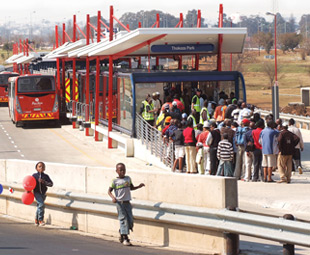
The outcome is a fleet of buses that is safe, reliable and on the road 99% of the time. GNT has grown into the single largest people carrier in Limpopo province as a result, and its continued growth is a marker of its success – a success shared by both Scania and Marcopolo, who recently secured the first bus rapid transit (BRT) contract issued by Gauteng for 143 buses.
“The awarding of the BRT tender to Scania, that has partnered with us, came as a direct result of our collective success with GNT,” revealed Janowski Da Cruz.
“The model our three companies have created here is an exemplary one,” agrees Ljungner. “Our ability to work with one another openly, honestly and with a shared goal of problem solving and best practice in mind has led to the individual growth of each of our companies, as well as a shared growth. Hopefully it won’t be too long before we celebrate GNT’s 1000th bus!”
Published by



focusmagsa