The big five in South America
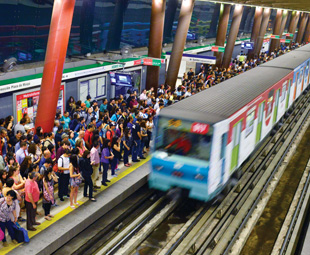
According to a blogger on the GoBackpacking website, known only as Ryan, one would be surprised to learn how great public transport is in some of South America’s more modern cities. He rates the top five as follows:
1. Subterraneo: Santiago, Chile
“Santiago might be one of the dullest big cities I’ve ever visited, but when it comes to public transport, it has no equal,” writes Ryan.
The first Subterraneo line opened in 1975, and today the system is extensive and modern – a primarily underground maze of trains that serve more than six-million people. “It works really well. I used it often when I was there,” says Ryan.
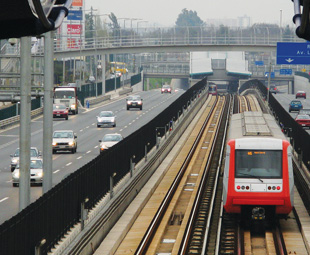 “I don’t care much about cleanliness as a factor for these rankings, but I am impressed when I see it, and the Subterraneo in Santiago has it. It’s quite a contrast from what you see above ground, where a layer of smog gives the city a hazy carapace of pollution.”
2. Subterraneo: Buenos Aires, Argentina
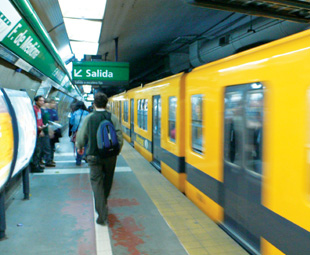
This is a close second according to Ryan. “The Subterraneo in Buenos Aires has everything Santiago does, except modern train cars, but I still enjoyed using the system,” he notes.
Its first section opened just over a hundred years ago, in 1913, and today it covers quite a big part of the Buenos Aires area, which is home to almost 13-million people.
“Riding the Subte, as it is often called, felt like using the New York Subway: it’s old and dirty, but gets you where you need to go,” he explains. “You just need to learn the map. For me, using the Buenos Aires Subte was easier than crossing ‘Avenida 9 de Julio’, the 14-lane thoroughfare – actually 18, if you count the two-lane access roads flanking each side of the avenue – that is the widest in the world.”
3. Transmilenio: Bogotá, Colombia
 Says Ryan: “I’ll tell you why I like the Transmilenio. First of all, it’s extensive; it covers a broad area of Bogotá where a cacophony of car horns blare in the streets – this metro area of more than ten-million people tests everyone’s patience.”
“Second,” he continues, “it’s relatively modern. The Transmilenio is a series of rapid transit buses, most of which have their own lanes, so they don’t have to fight through the same traffic that provokes so many drivers to hit their steering wheels.”
“Only the Septima line runs with the other vehicles on the road, but that’s fine. It’s worth the sacrifice to ride to the Usaquen, Bogotá’s prettiest neighbourhood,” he adds.
4. Metro: Medellín, Colombia
“For the pro-Metro readers, who are aghast now over its ranking below the Transmilenio, let me explain,” begins Ryan. “I’ll start with the good stuff. I love how modern the system is with its above-ground trains, 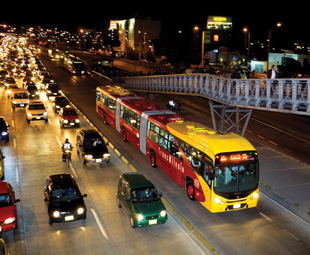 rapid transit buses, cable cars, and soon, a tram east of downtown. All of that is great. It’s also a lot cleaner than the Transmilenio, but I don’t care about cleanliness.”
Ryan says: “I just need to get to as many places as possible without a car, and the Transmilenio covers a lot more ground than the Medellín Metro system. Maybe someday, as Medellín grows and more additions are completed in the system, I can move the Medellín up.”
5. Metro: Recife, Brazil
“Yes, I’m taking Recife over Rio de Janeiro for the same reason I picked the Transmilenio over the Medellín Metro: extension,” explains Ryan.
“The Recife system is nothing special, but it seems to serve more people than the system in Rio, where the system is basically one line – albeit a very long line, but I can’t imagine one line is enough for a metropolitan area of more than 12,5-million people.”
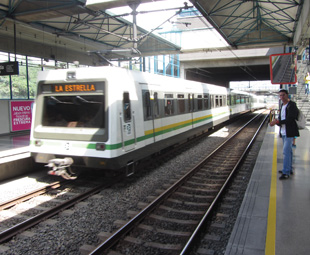 In Recife, there are three lines: one runs north-south and two run east-west, one of which veers off to the intercity bus terminal.
“I’ll admit, I have yet to go to Rio, but I’ve talked to friends, who are from there, or who have been there, and it just doesn’t serve as big an area as it should. At least the folks in Rio can say one thing: they’re better off than those in São Paulo!” he concludes.
Published by



focusmagsa