Big boa(s)ting with maritime Africa
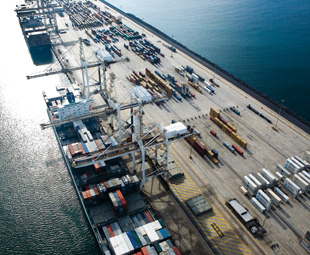
The world has shrunk to a mere global village as cargo can be sourced and delivered to and from every corner of our planet … FOCUS attends the Transport Forum’s Special Interest Group (SIG) meeting in Cape Town to bring you the latest on maritime news
Last year’s final instalment of this monthly event took place on December 5, on the tenth floor of the Transnet National Ports Authority House, at the Port of Cape Town. It delivered magnificent views and eye-opening presentations about Africa’s maritime industry.
“Our theme of global supply chain visibility is extremely important,” explains Harry van Huyssteen, custodian of the Transport Forum. “You have to know what is going on across your entire supply chain. It is important in terms of understanding your demand.”
And in Africa sea freight plays a major part in the supply and demand chain. Selma Schwartz – senior manager of Industry Development at the South African Maritime Safety Authority (SAMSA) – explains that 90 percent of the continent’s imports and exports are conducted by sea.
“Expanding Africa’s trade is vital for the economic prosperity of its people. A one percent increase in our share of the world trade would generate an extra US$182 billion (around R1 885 billion), which is about the size of Algeria’s annual gross domestic product,” Schwartz relates.
So if Africa could bump up its global trade share from 3,2 to 4,2 percent it could get a much larger slice of the global US$18,2 trillion (R188,6 trillion) pie. This is totally achievable when we look at the importance of the South African ports system. Willie Coetsee, corporate strategy manager at Transnet Port Terminals, explains: “The location of the South African ports system enables it to access trade to and from South America, the Far East, Europe, the United States as well as regional trade between eastern and western Africa.”
He adds that the shortest route between Shanghai (China) and Santos (Brazil) is via South Africa. “It is 11 270 nautical miles (nm) which is 20 872 km, and will take you 22 days if travelling at 21 knots (39 km/h).” Via the Panama Canal, which is 13 130 nm (24 316 km), it will take 26 days and via the Suez Canal it will take 27 days – both of these options have an additional transit fee attached.
So, as Coetsee asks, why don’t we trade more if we have the ports and such a prime location? “If you look at the trade balance, we imported goods to the value of about R100 million from China, but only exported goods to the value of R16 million in 2011,” he explains. “So there is a trade imbalance with China.”
But this imbalance doesn’t apply only to China as South Africa imported goods worth around R76 million from Germany and only exported goods to the value of
R34 million in 2011. As for Japan, our country’s imports reached R34 million and the exports R23 million.
Coetzee points out that a possible solution is to trade more in manufactured goods and less in our raw materials.
“A good example is that we export more goods to Zimbabwe than to China. And most of these exports are manufactured goods,” he says – adding that interregional trade in Africa needs to grow. “Unfortunately, of all the trade on the continent, only 12 percent is done amongst African countries.”
Another challenge facing the African maritime industry is that 95 percent of the sea freight being imported and exported is carried by foreign-owned deep sea going vessels. “There are a lot of debates about whether foreign vessels should be carrying South African cargo, the implications for our economy and how this issue should be addressed,” Schwartz emphasises. “We’re looking at it in terms of the legislative environment and how we can create an enabling environment for the maritime industry in South Africa.” But this is still open for debate.
However, SAMSA – along with other stakeholders on the continent – is working on creating an enabling environment for sea cadets. One such development is the acquisition of the SA Agulhas, an ice strengthened research vessel. After being used for more than 30 years the vessel was replaced by the SA Agulhas II.
This acquisition forms part of Africa’s Integrated Maritime Strategy, which aims to address the continent’s socio-economic challenges by promoting the concept of African indigenous tonnage being supported by African shipping companies, thereby enhancing intra-Africa regional trade.
“Previously we did not have a ship for South African cadets who had completed their theory and were in need of berths,” Schwartz explains. “So they did their theory and then disappeared. But now they’re able to complete their training locally on the SA Agulhas.”
Schwartz points out that South Africa now has the capacity to develop world-class seafarers. “And the SA Agulhas is enabling them to complete their sea time and then get a job on a vessel somewhere.”
So, despite some challenges, the South African and African maritime sectors have the potential to play a pivotal role in addressing some of the continent’s developmental challenges, as well as to deliver wonderful economic benefits to all Africans. It will take a lot of debate and hard work, but it appears that it is achievable if everyone works together.
Published by



focusmagsa